Another round-up of recent reviews! At last I have a Banshee (meaning I have to update all the reviews bemoaning the lack of Banshee), plus there's updated comic-based Black Widow and Tigra figures and I've updated my homemade Shocker. The imminence of Infinity War means some guesses at Steve Rogers, the Black Widow and Iron Man, while also from the Marvel Multiverse comes a suited versions Whiplash and Killmonger plus Peggy Carter as Captain America. DC gets a new updated Flash, Saint Walker, Indigo-1, Black Hand, Parallax, and Golden Age Reverse-Flash. The Arrowverse finally gets a Huntress and an Overgirl, while from the DC animated universe there's the Justice Lord Batman; Bats also gets an Orange Lantern version.
Showing posts with label Iron Man. Show all posts
Tuesday, 6 March 2018
Minifixation - Update 06/03/18
Another round-up of recent reviews! At last I have a Banshee (meaning I have to update all the reviews bemoaning the lack of Banshee), plus there's updated comic-based Black Widow and Tigra figures and I've updated my homemade Shocker. The imminence of Infinity War means some guesses at Steve Rogers, the Black Widow and Iron Man, while also from the Marvel Multiverse comes a suited versions Whiplash and Killmonger plus Peggy Carter as Captain America. DC gets a new updated Flash, Saint Walker, Indigo-1, Black Hand, Parallax, and Golden Age Reverse-Flash. The Arrowverse finally gets a Huntress and an Overgirl, while from the DC animated universe there's the Justice Lord Batman; Bats also gets an Orange Lantern version.
Labels:
Avengers,
Batman,
Captain America,
DC,
Iron Man,
Marvel,
Minifigures,
Not Lego,
Toys,
X-Men
Tuesday, 30 January 2018
Minifixation Update
More fresh piping hot reviews! From the Marvel universe there's the sensational She-Hulk, the improbable Nick Fury Jr, Sunspot, a stealth-suited Iron Man, the Red Widow, a bigger cuter Kingpin, Black Tom Cassidy and the Executioner Skurge.
The Marvel Cinematic Universe gets updated versions of Drax and Yondu, the Janet van Dyne version of the Wasp, Spider-Man's flashy new Infinity War suit, the Brickfig Hulkbuster, Justin Hammer, Odin and the Patriot.
From DC comics there's Jim Gordon as Batman, Bruce Wayne, Star Sapphire, Jessica Cruz and Lois Lane, while their animated spin-offs turn up Robin and Red X.
Plus of course a surprise appearance from Captain Canuck.
The Marvel Cinematic Universe gets updated versions of Drax and Yondu, the Janet van Dyne version of the Wasp, Spider-Man's flashy new Infinity War suit, the Brickfig Hulkbuster, Justin Hammer, Odin and the Patriot.
From DC comics there's Jim Gordon as Batman, Bruce Wayne, Star Sapphire, Jessica Cruz and Lois Lane, while their animated spin-offs turn up Robin and Red X.
Plus of course a surprise appearance from Captain Canuck.
Labels:
Batman,
Iron Man,
Minifigures,
Not Lego,
Robin,
Spider-Man
Thursday, 16 March 2017
Comic Review: Iron Man 2020
PUBLISHER: MARVEL (1984-1986), MARVEL UK (1989), MARVEL (1993-1994, 2008-2009)
WRITERS: TOM DeFALCO, FRED SCHILLER, KEN MACDONALD, SIMON FURMAN, WALTER SIMONSON, BOB WIACECK, DANIEL MERLIN GOODBREY
ARTISTS: BARRY WINDSOR-SMITH, HERB TRIMPE, MARK BEACHUM, BRYAN HITCH, WILLIAM ROSADO, LOU KANG, MANNY GALAN
Got to love a rogue obscure character getting a trade. The most fun thing about Iron Man 2020 (the hope of this blog is to avoid the obvious, so don't expect much bantz about how this will be happening in three years time) is that somehow, somehow, despite being popular with fans the character's still been sparsely used. To fill this trade whichever magnificent sod decided to run this collection has had to chase through issues of Machine Man, Spider-Man annuals, a nineties one-shot no-one remembers and the Astonishing Tales webcomic and even then rope in a storyline from What If. This is some editor's labour of love and I salute them. Quite what makes Arno Stark so appealing is a difficult thing to put the finger on; he's sort-of a bad version of relative (their exact relation is fuzzy, not least as 2020 started looking like a perfectly viable date for Iron Man to still be running) Tony Stark but not in a particularly evil way exactly, he's just a mercenary and a corporate bastard. Sort of what Tony Stark would actually be like in the real world, without telegraphed alcoholism or Skrull replacements or anything to offer a bailout.
The character debuted in a comic which isn't even really about him, Tom DeFalco's reworking of Machine Man. Arno shows up in the first issue briefly then armoured up at the end of the second before being the antagonist (at the behest of Sunset Bain) in the last couple of issues but it's not a problem because the mini-series itself is excellent, a much-underrated gem of the era for Marvel. Machine Man had been around for years as a crap Silver Age idea that the company tried to push for a couple of years before giving up on; here he's awoken in a dystopia proto-cyberpunk 2020 by the Midnight Wreckers, a group of rogue robot salvage outlaws making a credit or two against the oppressive corporate might of Baintronics. The 2000AD-tinged world was met with rounded characterisation and a revitalised Machine Man, whose push for his own rights as a sentient being were better framed than in the cheesy original. The story, ably illustrated by Herb Trimpe & Barry Windsor-Smith, might just be DeFalco's crowning moment and it's fantastic how fresh the universe feels. Against all this is Arno, whose arrogance and disdain leads to an epic defeat. It's not an auspicious debut in those terms but the character is interesting just as everyone else in the series is, fully rounded and with well-mapped motivations. Incredibly the series was barely followed up on, which perhaps adds to its' special feeling.
The arrogance and bullheadedness of Arno is brought into full force for his second appearance, as a guest villain in the 1986 Amazing Spider-Man Annual. The story was fairly simple as Stark travelled back in time to try and prevent the future destruction of Stark Industries (and the death of his wife and child) at the hands of a terrorist with one of his own advanced nukes to try and stop the bomber in his youth. Spider-Man spots the aforementioned attempts and Arno's mix of clumsy, unilateral methods lead to a misunderstanding, a battle and a you-guessed-it ending. What's fascinating is the amount of focus given to Arno; the symbiote-suited Spider-Man doesn't appear until the 16th page and even then isn't given much more to do than to react to the antagonist. The whole drive is from the Iron Man end even if it's Spider-Man's comic and era and if this wasn't part of a push for some sort of Iron Man 2020 solo series I'll eat three of my fingers. The result is further rounding out of a flawed but more or less decent man who lets his ambition and stubborn inability to explain himself to anyone get the better of him and it makes for a rather good story, livened up by a solid cross-town brawl.
The Machine Man mini had been ran as a back-up strip in Marvel UK's Transformers and, the British people being weird from even a young age, gave Arno such a cult following that the Spider-Man appearance was also printed in the UK when things like Armor Wars weren't. As such he was roped in for the final issue of the British arm's Death's Head series, written by Simon Furman and drawn by Bryan Hitch. The titular mechanoid and poor old Arno are set up by a thrill-seeking ultra-powerful society named the Dicemen to fight for entertainment though naturally after a bit of a dust-up they both realise they've been had and go out for vengeance. Arno actually comes out of the whole thing better than the star of the comic and it's another fun little stop on his weird ride.
A couple of cameos aside though he then spent another few years out of print before inexplicably surfacing in 1994 in his own 64-page graphic novel. No-one knows why. It's possible it was some old pitch or plan from the eighties someone turned up in a draw or something but I've just made that up so I'd be surprised. The prestige format one-shot was written by Walt Simonson and Bob Wiacek and concerns Arno being hired to rescue a businessman's hostage; the idea of the guy getting his own story with his own name up there on the cover is intoxicating but alas Simonson is as much of a dullard as ever and really you're reading any old Iron Man filler story set slightly in the future; the last-page revelation that an aged Tony is actually overseeing Arno's new career as a boring traditional hero rubber-stamps the character decay.
The one-shot went down so well that Arno disappeared for another decade or so before resurfacing in Marvel's webcomic revival of Astonishing Tales (later being selected for the print version as well). The writer was webcomic pioneer Daniel Merlin Goodbrey, courted by Marvel to give the format some cachet; considering he's British it's not too much of a reach to imagine the choice of character was influenced by those Transformers reprints once again. Whatever the reason Arno's back in proper morally questionable form fighting sky pirates and the result is good fun for the most part, though I'm not sure about Lou Kang's hunched up armour redesign (even if he's not dumb enough to remove the bevelled shoulders).
Finally to top things off there's a What If, or at least a bit of one. The issue, #53 from 1993, was a triple-header and it looks like being a deadline issue; all three were written by Furman and each featured a different crap artist. For the Iron Man 2020 segment it's Manny Galan, long known as a bit of a joke for his work on Transformers - Generation 2, where he worked like a maniac to pull back the title's backlog while trying to ape Derek Yaniger's style. Those were obviously circumstances that brought out the best in him as here his work looks like it's out of a colouring book, and not a particularly great one either, probably a Chinese bootleg with Unkillable Steel Fellow daubed on the front. It poises the question of what would have happened if Arno had been left in the present after his run-in with Spider-Man; it turns out he would have taken advantage of Tony Stark's disappearance a few years down the line, killed Jim Rhodes (who really should never do What Ifs as he dies ridiculously easily) and then got put in his place by Tony almost immediately before going on to be an abusive father who would vaguely do some sort of self-fulfilling prophecy thing because something similar happened in the Spider-Man comic and Furman thinks it's clever but doesn't really understand.
So yeah, it's a collection of highs and lows as such an eclectic grab-bag of sources would suggest but really the Machine Man story alone is worth the price, with the Spider-Man and Death's Head issues worthy inclusions as well. The less said about Simonson's effort the better but I suppose it being here means you're less likely to get fascinated by the better parts and go and spend money on the thing like a sucker. No bitterness. The revival feels odd in there with its' digital colouring but is a harmless little oddity while the presence of the What If is not only a testament to completism but means if you're reading the book in the bathroom there's some emergency toilet paper on hand. The character was more recently revived for Kang's Chronos Corps, so this makes a solid primer.
WRITERS: TOM DeFALCO, FRED SCHILLER, KEN MACDONALD, SIMON FURMAN, WALTER SIMONSON, BOB WIACECK, DANIEL MERLIN GOODBREY
ARTISTS: BARRY WINDSOR-SMITH, HERB TRIMPE, MARK BEACHUM, BRYAN HITCH, WILLIAM ROSADO, LOU KANG, MANNY GALAN
Got to love a rogue obscure character getting a trade. The most fun thing about Iron Man 2020 (the hope of this blog is to avoid the obvious, so don't expect much bantz about how this will be happening in three years time) is that somehow, somehow, despite being popular with fans the character's still been sparsely used. To fill this trade whichever magnificent sod decided to run this collection has had to chase through issues of Machine Man, Spider-Man annuals, a nineties one-shot no-one remembers and the Astonishing Tales webcomic and even then rope in a storyline from What If. This is some editor's labour of love and I salute them. Quite what makes Arno Stark so appealing is a difficult thing to put the finger on; he's sort-of a bad version of relative (their exact relation is fuzzy, not least as 2020 started looking like a perfectly viable date for Iron Man to still be running) Tony Stark but not in a particularly evil way exactly, he's just a mercenary and a corporate bastard. Sort of what Tony Stark would actually be like in the real world, without telegraphed alcoholism or Skrull replacements or anything to offer a bailout.
The character debuted in a comic which isn't even really about him, Tom DeFalco's reworking of Machine Man. Arno shows up in the first issue briefly then armoured up at the end of the second before being the antagonist (at the behest of Sunset Bain) in the last couple of issues but it's not a problem because the mini-series itself is excellent, a much-underrated gem of the era for Marvel. Machine Man had been around for years as a crap Silver Age idea that the company tried to push for a couple of years before giving up on; here he's awoken in a dystopia proto-cyberpunk 2020 by the Midnight Wreckers, a group of rogue robot salvage outlaws making a credit or two against the oppressive corporate might of Baintronics. The 2000AD-tinged world was met with rounded characterisation and a revitalised Machine Man, whose push for his own rights as a sentient being were better framed than in the cheesy original. The story, ably illustrated by Herb Trimpe & Barry Windsor-Smith, might just be DeFalco's crowning moment and it's fantastic how fresh the universe feels. Against all this is Arno, whose arrogance and disdain leads to an epic defeat. It's not an auspicious debut in those terms but the character is interesting just as everyone else in the series is, fully rounded and with well-mapped motivations. Incredibly the series was barely followed up on, which perhaps adds to its' special feeling.
The arrogance and bullheadedness of Arno is brought into full force for his second appearance, as a guest villain in the 1986 Amazing Spider-Man Annual. The story was fairly simple as Stark travelled back in time to try and prevent the future destruction of Stark Industries (and the death of his wife and child) at the hands of a terrorist with one of his own advanced nukes to try and stop the bomber in his youth. Spider-Man spots the aforementioned attempts and Arno's mix of clumsy, unilateral methods lead to a misunderstanding, a battle and a you-guessed-it ending. What's fascinating is the amount of focus given to Arno; the symbiote-suited Spider-Man doesn't appear until the 16th page and even then isn't given much more to do than to react to the antagonist. The whole drive is from the Iron Man end even if it's Spider-Man's comic and era and if this wasn't part of a push for some sort of Iron Man 2020 solo series I'll eat three of my fingers. The result is further rounding out of a flawed but more or less decent man who lets his ambition and stubborn inability to explain himself to anyone get the better of him and it makes for a rather good story, livened up by a solid cross-town brawl.
The Machine Man mini had been ran as a back-up strip in Marvel UK's Transformers and, the British people being weird from even a young age, gave Arno such a cult following that the Spider-Man appearance was also printed in the UK when things like Armor Wars weren't. As such he was roped in for the final issue of the British arm's Death's Head series, written by Simon Furman and drawn by Bryan Hitch. The titular mechanoid and poor old Arno are set up by a thrill-seeking ultra-powerful society named the Dicemen to fight for entertainment though naturally after a bit of a dust-up they both realise they've been had and go out for vengeance. Arno actually comes out of the whole thing better than the star of the comic and it's another fun little stop on his weird ride.
A couple of cameos aside though he then spent another few years out of print before inexplicably surfacing in 1994 in his own 64-page graphic novel. No-one knows why. It's possible it was some old pitch or plan from the eighties someone turned up in a draw or something but I've just made that up so I'd be surprised. The prestige format one-shot was written by Walt Simonson and Bob Wiacek and concerns Arno being hired to rescue a businessman's hostage; the idea of the guy getting his own story with his own name up there on the cover is intoxicating but alas Simonson is as much of a dullard as ever and really you're reading any old Iron Man filler story set slightly in the future; the last-page revelation that an aged Tony is actually overseeing Arno's new career as a boring traditional hero rubber-stamps the character decay.
The one-shot went down so well that Arno disappeared for another decade or so before resurfacing in Marvel's webcomic revival of Astonishing Tales (later being selected for the print version as well). The writer was webcomic pioneer Daniel Merlin Goodbrey, courted by Marvel to give the format some cachet; considering he's British it's not too much of a reach to imagine the choice of character was influenced by those Transformers reprints once again. Whatever the reason Arno's back in proper morally questionable form fighting sky pirates and the result is good fun for the most part, though I'm not sure about Lou Kang's hunched up armour redesign (even if he's not dumb enough to remove the bevelled shoulders).
Finally to top things off there's a What If, or at least a bit of one. The issue, #53 from 1993, was a triple-header and it looks like being a deadline issue; all three were written by Furman and each featured a different crap artist. For the Iron Man 2020 segment it's Manny Galan, long known as a bit of a joke for his work on Transformers - Generation 2, where he worked like a maniac to pull back the title's backlog while trying to ape Derek Yaniger's style. Those were obviously circumstances that brought out the best in him as here his work looks like it's out of a colouring book, and not a particularly great one either, probably a Chinese bootleg with Unkillable Steel Fellow daubed on the front. It poises the question of what would have happened if Arno had been left in the present after his run-in with Spider-Man; it turns out he would have taken advantage of Tony Stark's disappearance a few years down the line, killed Jim Rhodes (who really should never do What Ifs as he dies ridiculously easily) and then got put in his place by Tony almost immediately before going on to be an abusive father who would vaguely do some sort of self-fulfilling prophecy thing because something similar happened in the Spider-Man comic and Furman thinks it's clever but doesn't really understand.
So yeah, it's a collection of highs and lows as such an eclectic grab-bag of sources would suggest but really the Machine Man story alone is worth the price, with the Spider-Man and Death's Head issues worthy inclusions as well. The less said about Simonson's effort the better but I suppose it being here means you're less likely to get fascinated by the better parts and go and spend money on the thing like a sucker. No bitterness. The revival feels odd in there with its' digital colouring but is a harmless little oddity while the presence of the What If is not only a testament to completism but means if you're reading the book in the bathroom there's some emergency toilet paper on hand. The character was more recently revived for Kang's Chronos Corps, so this makes a solid primer.
Sunday, 5 March 2017
Comic Review: Heroes Reborn Part 12 - The Return
PUBLISHER: MARVEL, 1997
WRITER: PETER DAVID
ARTIST: SALVADOR LAROCCA
Produced totally in house, this was a four-part weekly mini coping with the matter of actualy physically returning the Fantatic Four and the Avengers to Earth-616. Written by proper writer Peter David and drawn by the excellenet Salvador Larocca it should have been a triumph but what's happening is a real mess. Most of the pertinent information is dumped in the recap of the first issue with the rest of it being about Franklin Richards (who isn't bad as comic kids go but is also not exactly great either) arguing for the survival of the world he created with the Eternal Ashema. It's something of a foregone conclusion that the snot-nosed little genius will convince her to save everyone and that our heroes will successfully traverse the journey back to their own world but really you'd hope for a better story to get there.
Franklin and Ashema's telegraphed dialogue - him trying to plead for the sanctity of all life, her seeing the big picture but wouldn't you know it gradually coming around - takes up far too much while the actual heroes are given a somewhat perfunctory role in it all. Franklin is able to project himself to Reed and Sue and tell them what's going on; they buy it and rapidly talk around everyone else. It would be a difficult thing to do well to be fair but that doesn't make it any easier to read as Tony Stark abandons Pepper or Cap leaves Bucky behind with no reason on the word of a kid from another universe. Amusingly the gathering of who's from the real world is conducted by Franklin from memory and he (or rather Peter David) gets it wrong by including several characters who weren't absorbed by Onslaught, including She-Hulk and several Inhumans (only Crystal, as a serving member of the Avengers, made the trip).
David throws in Spider-Man (a hapless passenger when the 616 Hulk and the HR Banner, separated in the battle with Onslaught, find themselves reunited) for no readily apparent reason beyond providing clunking exposition, which considering that sort of thing fills every avaliable narration box feels a bit needy. The one flash of innovation comes later on when Dr Doom attempts to betray everyone by taking Franklin back to the Heroes Reborn Earth, hoping to rule it unopposed. While Franklin is saved Doom does end up going back to set up a thread on what would become known as Counter-Earth that was occasionally revisited; this avenue full of potential, with the planet packed with villains created by Franklin and opposed only by a handful of heroes like Bucky and the Swordsman, would get the occasional visit but was sadly never fully explored. And there was a Jeph Loed Rob Liefield revisit to the whole Onslaught thing in 2006; you cannot pay me enough to read that.
It's an underwhelming end to an underwhelming experiment; the general feeling is that Marvel want to get these guys back in order as soon as possible and just get over the whole thing. The four titles would relaunch under the Heroes Return banner with tip-top creators including the magnificent Kurt Busiek, Alan Davis, George Perez, Mark Waid, Scott Lobdell and Sean Chen.
The universe's more telling legacy might have been in the Ultimate universe which launched two years later. The Ultimate series made a clean break with the rest of Marvel's output and didn't replace the long-established originals, featured decompressed storytelling that gradually introduced both heroes and the updated versions of their supporting cast rather than the breakneck pace of the Heroes Reborn titles. Young, hip writing talent was recruited to match the stature of the artists rather than trying to revisit old glories. The result was hugely successful and while it inevitably began to collapse in on itself after a decade Heroes Reborn managed that in months, so the lessons would seem to have been learnt.
WRITER: PETER DAVID
ARTIST: SALVADOR LAROCCA
Produced totally in house, this was a four-part weekly mini coping with the matter of actualy physically returning the Fantatic Four and the Avengers to Earth-616. Written by proper writer Peter David and drawn by the excellenet Salvador Larocca it should have been a triumph but what's happening is a real mess. Most of the pertinent information is dumped in the recap of the first issue with the rest of it being about Franklin Richards (who isn't bad as comic kids go but is also not exactly great either) arguing for the survival of the world he created with the Eternal Ashema. It's something of a foregone conclusion that the snot-nosed little genius will convince her to save everyone and that our heroes will successfully traverse the journey back to their own world but really you'd hope for a better story to get there.
Franklin and Ashema's telegraphed dialogue - him trying to plead for the sanctity of all life, her seeing the big picture but wouldn't you know it gradually coming around - takes up far too much while the actual heroes are given a somewhat perfunctory role in it all. Franklin is able to project himself to Reed and Sue and tell them what's going on; they buy it and rapidly talk around everyone else. It would be a difficult thing to do well to be fair but that doesn't make it any easier to read as Tony Stark abandons Pepper or Cap leaves Bucky behind with no reason on the word of a kid from another universe. Amusingly the gathering of who's from the real world is conducted by Franklin from memory and he (or rather Peter David) gets it wrong by including several characters who weren't absorbed by Onslaught, including She-Hulk and several Inhumans (only Crystal, as a serving member of the Avengers, made the trip).
David throws in Spider-Man (a hapless passenger when the 616 Hulk and the HR Banner, separated in the battle with Onslaught, find themselves reunited) for no readily apparent reason beyond providing clunking exposition, which considering that sort of thing fills every avaliable narration box feels a bit needy. The one flash of innovation comes later on when Dr Doom attempts to betray everyone by taking Franklin back to the Heroes Reborn Earth, hoping to rule it unopposed. While Franklin is saved Doom does end up going back to set up a thread on what would become known as Counter-Earth that was occasionally revisited; this avenue full of potential, with the planet packed with villains created by Franklin and opposed only by a handful of heroes like Bucky and the Swordsman, would get the occasional visit but was sadly never fully explored. And there was a Jeph Loed Rob Liefield revisit to the whole Onslaught thing in 2006; you cannot pay me enough to read that.
It's an underwhelming end to an underwhelming experiment; the general feeling is that Marvel want to get these guys back in order as soon as possible and just get over the whole thing. The four titles would relaunch under the Heroes Return banner with tip-top creators including the magnificent Kurt Busiek, Alan Davis, George Perez, Mark Waid, Scott Lobdell and Sean Chen.
The universe's more telling legacy might have been in the Ultimate universe which launched two years later. The Ultimate series made a clean break with the rest of Marvel's output and didn't replace the long-established originals, featured decompressed storytelling that gradually introduced both heroes and the updated versions of their supporting cast rather than the breakneck pace of the Heroes Reborn titles. Young, hip writing talent was recruited to match the stature of the artists rather than trying to revisit old glories. The result was hugely successful and while it inevitably began to collapse in on itself after a decade Heroes Reborn managed that in months, so the lessons would seem to have been learnt.
Labels:
Avengers,
Captain America,
Comic,
Crossover,
Fantastic Four,
Heroes Reborn,
Hulk,
Iron Man,
Mini Series,
Peter David,
Salvador Larocca,
TPB
Minifigures - The Avengers, Part 4
Rounding up the rest of my Avengers Minifigures (bar a few peripheral members who belong more with other groups) this is really just an overview of the handful of characters to join between the late seventies and the title's drastic reformatting under Brian Michael Bendis to have really made much of an impression; I've always liked most of the roster but really it's not hard to see why no-one's come up with a Minifigure of Firebird or Jack of Hearts.
Carol Danvers has been around since the sixties and has had almost as many superhero personas and character annihilations as Hank Pym. Ms Marvel is probably still her most famous, a role initially ended to give Rogue a big launch, though she's since come back. This figure captures her most famous costume, the second Ms Marvel one which came back in the nineties when Kurt Busiek returned her to the spotlight as Warbird and stuck around until she became Captain Marvel. It gets the look down to a tee, with the lightning flash on the chest and the (thankfully painted considering some of the missteps with fabric) sash tie while the extant Lego hair piece fits her like a glove. Available either officially or as a Chinese bootleg, this is one of the most impressive figures out there.
Sam was always more Captain America's sidekick but for a while that basically guaranteed your slot anyway. Since then he didn't really do much in the title for years - Geoff Johns' attempts to make the book entirely about the Falcon and how great he is went down so well Marvel drafted in Chuck Austen to stop him - until Marvel decided he could become Captain America himself and lead the team. This figure - officially available in the Hulk Lab Smash set but also bootlegged by the Chinese - has a fair stab at one of the many red-and-white costumes he wore but errs in a couple of ways. Firstly the wings are not only inexplicably transparent but are also permanently spread, which is fine for play but a pain for a display. The other is limited to the bootleg, where whoever makes these things seems to have taken the gold gloves as skin tone and greatly lightened the face accordingly, leading to a Hispanic look.
Wonder Man first turned up as a bad guy in the Avengers in 1964, seemingly getting killed straight away; after various cameos he finally made the team some 13 years later - Stan Lee has claimed this was partly due to a gentleman's agreement with DC, who cried foul on the name's similarity to Wonder Woman then later brought out Power Girl in apparent violation despite Marvel already having Power Man, leading them to discard the deal. The character has since been a respectable tier 2 Avenger but has always seemed just that bit too naff for the real mainstream, with his mullet, long stint in the perennially unfashionable West Coast Avengers and dodgy nineties solo series. As such there have been no official or unofficial Minifigures of him; thankfully even an idiot like me can knock one up overlaying a red 'W' on a black muscled chest, finding some red eyes (easily found from Superman, though live action Hawkeye's red shades provide a 'powered down' alternative) and then just picking a relatively unhumiliating hairstyle.
One of the functions of the Avengers as a book was to pick up characters during lean times and that was the story of Tigra, invented in the mid-seventies as an updated Patsy Walker for the girls and rapidly cancelled. She was resurrected in the eighties as an Avenger, only briefly appearing in the main book before being sent off to the West Coast for about half of the team's run and making occasional guest appearances afterwards. As a sexy cat lady she's sort-of tarred by the whole furry thing now and has received little attention. Thankfully Penzora has once again delivered an excellent Minifigure capturing her in her stripy, bikini-wearing eighties glory; she could perhaps do with a tail but the only tiger-patterned one out there is from the much lighter 2015 Monsters Tiger Woman Minifigure.
Like Tigra, She-Hulk was another failed launch folded into the Avengers line-up after her own solo title stalled; she would then go on to do a stint in the Fantastic Four before her second, better-remembered feature book in the late eighties, a mad run of self-awareness and weird jokes. Bruce's cousin Jen has since become something of a favourite at the company, who continue to push series despite underwhelming sales. She's finally got an official Minifigure at the start of 2017 as part of a showdown between herself and the Hulk and their red counterparts; a bootleg based on her video game appearance has been doing the rounds for some time however and isn't bad, with the purple/white leotard worn for most of the solo series. Unlike the official version it sadly doesn't feature the green-tinged hair, also featuring an angry face and a different set of physical details.
Bobbi Morse started off as a side character in various Ka-Zar strips which saw her become a SHIELD Agent and then a costumed vigilante named Huntress. To avoid yet another clash with DC she was renamed Mockingbird and then romantically linked to Hawkeye, marrying him and becoming a founding member of the West Coast Avengers (having appeared in the main book as a supporting non-team character). She left the team in a messy Johnny Byrne plot but eventually returned in time to die in a late issue at the hands of Mephisto. Although wait, Marvel's ongoing creative bankruptcy meant that after some 17 years of her being dead it was reveals a Skrull duplicate had bought the farm instead. Sadly this recent interest hasn't been enough to get her in a film or into Minifig form but Penzora again has me covered; the costume of their custom is spot-on though the character has the more modified recent mask; personally I'd have prefered the amazing flying-v shaped one she wore in the eighties but that remains unfortunately beyond the reach of Lego.
Iron Man of course had been in and out of the Avengers since founding them but the eighties saw his natty red/silver (well, white) armour come to the fore, just in time for him to join up with the West Coast Avengers. There's not been a figure of the armour exactly but it did get used in Iron Man 3 as one of Tony's specialist armours and was brought out in one of the Lego Age of Ultron sets, which has been bootlegged (bootleggers love Iron Man variant armours). Not only are the details retouched accordingly but there's an additional shoulder pad arrangement including decorated tiles on the chest and back that really make the result look quite different - if not quite like the eighties comic version - while also de-emphasising how bulbous the opening helmet is.
One of the more unpleasant heroes of the era, John Walker first stood in for Captain America and made an arse of that before taking up the guise of U.S. Agent, where he was more or less on the side of right but tended to be a bit of a narc and never really got on with anyone. He was shoe-horned onto the West Coast Avengers roster by the government and spent most of his stint as an unwelcome presence. At the time the character was garbed in the uniform Steve Rogers had worn as the Captain and it's an easy one to replicate thanks to the Captain Hydra figures out there; a dab of black paint on the shield and the substitution of a plain black torso with a simple sticker makes for a convincing version of his eighties/nineties look as it's highly unlikely a character who was never that popular in or out of the fictional universe will get an official figure.
While Quasar has one way or another been in existence since 1979 (originally as Marvel Boy, using the Timely character's cosmic bracelets) his stint on the Avengers came ten years later; unlike Mockingbird or She-Hulk his presence wasn't to give him a new home but as part of a double-pronged attempt to push the character, Wendell being given his own concurrent solo series at the same time as his membership. Despite a lot of effort he never really took off however and has since been reduced to guest spots; should Marvel go for cosmic Avengers in the films he's likely to be behind the various Captain Marvels if nothing else. However, Penzora have again obliged with a lushly coloured custom based largely on his nineties look that does the job well in the face of official apathy; my only criticism is the trendy hair he's got. Really I need to find him a nice blond mullet.
James Rhodes had already served on both the main and West Coast Avengers teams during his first fill-in stint as Iron Man before later taking on the guise of War Machine and getting a slot on the latter in the end days before the team reunited. That was at about the point the character's brief fame was declining but the interest in anything Iron Man following the films' success and the easy repaint potential has given him a couple of official figures - which have again been bootlegged. The main changes are the presence of Rhodey's face under the helmet and the addition of a neat clear backpack bracket for mounting weaponry; this is ripe for a bit of customising fun. Naturally the painted detail is closer to the live action suits but it does the job for a nineties version of the character too if that's what you're after.
MS MARVEL
Carol Danvers has been around since the sixties and has had almost as many superhero personas and character annihilations as Hank Pym. Ms Marvel is probably still her most famous, a role initially ended to give Rogue a big launch, though she's since come back. This figure captures her most famous costume, the second Ms Marvel one which came back in the nineties when Kurt Busiek returned her to the spotlight as Warbird and stuck around until she became Captain Marvel. It gets the look down to a tee, with the lightning flash on the chest and the (thankfully painted considering some of the missteps with fabric) sash tie while the extant Lego hair piece fits her like a glove. Available either officially or as a Chinese bootleg, this is one of the most impressive figures out there.
THE FALCON
Sam was always more Captain America's sidekick but for a while that basically guaranteed your slot anyway. Since then he didn't really do much in the title for years - Geoff Johns' attempts to make the book entirely about the Falcon and how great he is went down so well Marvel drafted in Chuck Austen to stop him - until Marvel decided he could become Captain America himself and lead the team. This figure - officially available in the Hulk Lab Smash set but also bootlegged by the Chinese - has a fair stab at one of the many red-and-white costumes he wore but errs in a couple of ways. Firstly the wings are not only inexplicably transparent but are also permanently spread, which is fine for play but a pain for a display. The other is limited to the bootleg, where whoever makes these things seems to have taken the gold gloves as skin tone and greatly lightened the face accordingly, leading to a Hispanic look.
WONDER MAN
Wonder Man first turned up as a bad guy in the Avengers in 1964, seemingly getting killed straight away; after various cameos he finally made the team some 13 years later - Stan Lee has claimed this was partly due to a gentleman's agreement with DC, who cried foul on the name's similarity to Wonder Woman then later brought out Power Girl in apparent violation despite Marvel already having Power Man, leading them to discard the deal. The character has since been a respectable tier 2 Avenger but has always seemed just that bit too naff for the real mainstream, with his mullet, long stint in the perennially unfashionable West Coast Avengers and dodgy nineties solo series. As such there have been no official or unofficial Minifigures of him; thankfully even an idiot like me can knock one up overlaying a red 'W' on a black muscled chest, finding some red eyes (easily found from Superman, though live action Hawkeye's red shades provide a 'powered down' alternative) and then just picking a relatively unhumiliating hairstyle.
TIGRA
One of the functions of the Avengers as a book was to pick up characters during lean times and that was the story of Tigra, invented in the mid-seventies as an updated Patsy Walker for the girls and rapidly cancelled. She was resurrected in the eighties as an Avenger, only briefly appearing in the main book before being sent off to the West Coast for about half of the team's run and making occasional guest appearances afterwards. As a sexy cat lady she's sort-of tarred by the whole furry thing now and has received little attention. Thankfully Penzora has once again delivered an excellent Minifigure capturing her in her stripy, bikini-wearing eighties glory; she could perhaps do with a tail but the only tiger-patterned one out there is from the much lighter 2015 Monsters Tiger Woman Minifigure.
SHE-HULK
Like Tigra, She-Hulk was another failed launch folded into the Avengers line-up after her own solo title stalled; she would then go on to do a stint in the Fantastic Four before her second, better-remembered feature book in the late eighties, a mad run of self-awareness and weird jokes. Bruce's cousin Jen has since become something of a favourite at the company, who continue to push series despite underwhelming sales. She's finally got an official Minifigure at the start of 2017 as part of a showdown between herself and the Hulk and their red counterparts; a bootleg based on her video game appearance has been doing the rounds for some time however and isn't bad, with the purple/white leotard worn for most of the solo series. Unlike the official version it sadly doesn't feature the green-tinged hair, also featuring an angry face and a different set of physical details.
MOCKINGBIRD
Bobbi Morse started off as a side character in various Ka-Zar strips which saw her become a SHIELD Agent and then a costumed vigilante named Huntress. To avoid yet another clash with DC she was renamed Mockingbird and then romantically linked to Hawkeye, marrying him and becoming a founding member of the West Coast Avengers (having appeared in the main book as a supporting non-team character). She left the team in a messy Johnny Byrne plot but eventually returned in time to die in a late issue at the hands of Mephisto. Although wait, Marvel's ongoing creative bankruptcy meant that after some 17 years of her being dead it was reveals a Skrull duplicate had bought the farm instead. Sadly this recent interest hasn't been enough to get her in a film or into Minifig form but Penzora again has me covered; the costume of their custom is spot-on though the character has the more modified recent mask; personally I'd have prefered the amazing flying-v shaped one she wore in the eighties but that remains unfortunately beyond the reach of Lego.
IRON MAN
Iron Man of course had been in and out of the Avengers since founding them but the eighties saw his natty red/silver (well, white) armour come to the fore, just in time for him to join up with the West Coast Avengers. There's not been a figure of the armour exactly but it did get used in Iron Man 3 as one of Tony's specialist armours and was brought out in one of the Lego Age of Ultron sets, which has been bootlegged (bootleggers love Iron Man variant armours). Not only are the details retouched accordingly but there's an additional shoulder pad arrangement including decorated tiles on the chest and back that really make the result look quite different - if not quite like the eighties comic version - while also de-emphasising how bulbous the opening helmet is.
U.S. AGENT
One of the more unpleasant heroes of the era, John Walker first stood in for Captain America and made an arse of that before taking up the guise of U.S. Agent, where he was more or less on the side of right but tended to be a bit of a narc and never really got on with anyone. He was shoe-horned onto the West Coast Avengers roster by the government and spent most of his stint as an unwelcome presence. At the time the character was garbed in the uniform Steve Rogers had worn as the Captain and it's an easy one to replicate thanks to the Captain Hydra figures out there; a dab of black paint on the shield and the substitution of a plain black torso with a simple sticker makes for a convincing version of his eighties/nineties look as it's highly unlikely a character who was never that popular in or out of the fictional universe will get an official figure.
QUASAR
While Quasar has one way or another been in existence since 1979 (originally as Marvel Boy, using the Timely character's cosmic bracelets) his stint on the Avengers came ten years later; unlike Mockingbird or She-Hulk his presence wasn't to give him a new home but as part of a double-pronged attempt to push the character, Wendell being given his own concurrent solo series at the same time as his membership. Despite a lot of effort he never really took off however and has since been reduced to guest spots; should Marvel go for cosmic Avengers in the films he's likely to be behind the various Captain Marvels if nothing else. However, Penzora have again obliged with a lushly coloured custom based largely on his nineties look that does the job well in the face of official apathy; my only criticism is the trendy hair he's got. Really I need to find him a nice blond mullet.
WAR MACHINE
James Rhodes had already served on both the main and West Coast Avengers teams during his first fill-in stint as Iron Man before later taking on the guise of War Machine and getting a slot on the latter in the end days before the team reunited. That was at about the point the character's brief fame was declining but the interest in anything Iron Man following the films' success and the easy repaint potential has given him a couple of official figures - which have again been bootlegged. The main changes are the presence of Rhodey's face under the helmet and the addition of a neat clear backpack bracket for mounting weaponry; this is ripe for a bit of customising fun. Naturally the painted detail is closer to the live action suits but it does the job for a nineties version of the character too if that's what you're after.
Labels:
Avengers,
Bootleg,
Iron Man,
Mashup,
Minifigures,
Not Lego,
Penzora,
Toys,
War Machine
Friday, 3 March 2017
Comic Review: Heroes Reborn Part 11 - World War 3
PUBLISHER: MARVEL, 1997
WRITER: JAMES ROBINSON
ARTISTS: MIKE WIERINGO, MICHAEL RYAN, LARRY STROMAN, RON LIM
With the 12-issue contract with Image (or more Wildstorm by this stage) done with and a glorious return to in-house at Marvel ready to go the Heroes Reborn universe seemed to have ran its' course. However, a 13th issue of each title still came out, a crossover with Wildstorm's superhero books. Why I'm not sure - maybe as a thanks to the company for stepping in, maybe as a contractual thing, maybe as a last-minute fill-in. There's a certain oddness to the way it's presented in that each issue has nothing on the cover really announcing the presence of the Wildstorm heroes, depending on readers recognising the likes of Maul and Burnout, so it doesn't seem to be to give the Image studio a big money-spinning golden handshake.
The rub is that via the Negative Zone an alliance of Doctor Doom, the Skrulls and the Daemonites have been able to bind the Wildstorm universe and the Heroes Reborn universe together through a dimensional lock and the resulting alliance is winning the battle for Earth. It's really just an excuse for some smashing mix-up team line-ups - the Fantastic Four consist of Reed, Sue, Maul and Burn-Out; the Avengers of Captain America (actually Hadrian from WildCATs), the Scarlet Witch, Thor, Hellstrike, the Swordsman, Freefall and Brass; Stormwatch are Battalion, Hawksmoor, Fuji, Fairchild, Winter, Jenny Sparks, the Vision and Triton of the Inhumans; Wetworks consist of Dane, Jester, Mother-One, Pilgrim and Hawkeye; WildCATs are made up of Lord Emp, Zealot, Goliath, Gorgon, Grifter, Warblade and Void. Iron Man, the Thing, the Human Torch, Namor, Deathblow and the Hulk among those already MIA, Captain America is off being Nomad and Nick Fury's just died, replaced by Jeremy Stone as head of SHIELD - whose main weapon is Dane Whitman's Black Knights. No, Dane didn't get Onslaughted but there he is.
Now, if that's all got your eyes rolling this isn't for you. But I love this kind of mash-up and the writer is the superlative James Robinson, who turns in an 88-page action thriller full of everything you want from a crossover. There are deaths galore, big action set pieces, minimal plot intrusion, smart lines and a general "deal with it" attitude. There's also lots of detail thrown in that makes this amalgamated universe feel more natural than it should and each issue manages a great "oh shit" moment. Most of the Wildstorm characters get short shrift surprisingly though it's not really a story where characterisation is the aim of the game anyway, more just increasingly violent deaths as the combined heroes realise Doom's game and try to separate the universes as much as possible.
It's arguable that part of the success is that the basis in Heroes Reborn is only really recognisable due to a few design choices (like the Iron Man armour) and a few cast choices (fair play to Robinson for remembering the Swordsman when most of the Avengers writers didn't). It all makes for some good balls-to-the-wall comic book fun, something lacking over the preceding year. Sadly, with the copyright situation of the Wildstorm characters now being owned by DC and World War 3 being so minor league a reprint looks unlikely and it does deserve better than that.
WRITER: JAMES ROBINSON
ARTISTS: MIKE WIERINGO, MICHAEL RYAN, LARRY STROMAN, RON LIM
With the 12-issue contract with Image (or more Wildstorm by this stage) done with and a glorious return to in-house at Marvel ready to go the Heroes Reborn universe seemed to have ran its' course. However, a 13th issue of each title still came out, a crossover with Wildstorm's superhero books. Why I'm not sure - maybe as a thanks to the company for stepping in, maybe as a contractual thing, maybe as a last-minute fill-in. There's a certain oddness to the way it's presented in that each issue has nothing on the cover really announcing the presence of the Wildstorm heroes, depending on readers recognising the likes of Maul and Burnout, so it doesn't seem to be to give the Image studio a big money-spinning golden handshake.
The rub is that via the Negative Zone an alliance of Doctor Doom, the Skrulls and the Daemonites have been able to bind the Wildstorm universe and the Heroes Reborn universe together through a dimensional lock and the resulting alliance is winning the battle for Earth. It's really just an excuse for some smashing mix-up team line-ups - the Fantastic Four consist of Reed, Sue, Maul and Burn-Out; the Avengers of Captain America (actually Hadrian from WildCATs), the Scarlet Witch, Thor, Hellstrike, the Swordsman, Freefall and Brass; Stormwatch are Battalion, Hawksmoor, Fuji, Fairchild, Winter, Jenny Sparks, the Vision and Triton of the Inhumans; Wetworks consist of Dane, Jester, Mother-One, Pilgrim and Hawkeye; WildCATs are made up of Lord Emp, Zealot, Goliath, Gorgon, Grifter, Warblade and Void. Iron Man, the Thing, the Human Torch, Namor, Deathblow and the Hulk among those already MIA, Captain America is off being Nomad and Nick Fury's just died, replaced by Jeremy Stone as head of SHIELD - whose main weapon is Dane Whitman's Black Knights. No, Dane didn't get Onslaughted but there he is.
Now, if that's all got your eyes rolling this isn't for you. But I love this kind of mash-up and the writer is the superlative James Robinson, who turns in an 88-page action thriller full of everything you want from a crossover. There are deaths galore, big action set pieces, minimal plot intrusion, smart lines and a general "deal with it" attitude. There's also lots of detail thrown in that makes this amalgamated universe feel more natural than it should and each issue manages a great "oh shit" moment. Most of the Wildstorm characters get short shrift surprisingly though it's not really a story where characterisation is the aim of the game anyway, more just increasingly violent deaths as the combined heroes realise Doom's game and try to separate the universes as much as possible.
It's arguable that part of the success is that the basis in Heroes Reborn is only really recognisable due to a few design choices (like the Iron Man armour) and a few cast choices (fair play to Robinson for remembering the Swordsman when most of the Avengers writers didn't). It all makes for some good balls-to-the-wall comic book fun, something lacking over the preceding year. Sadly, with the copyright situation of the Wildstorm characters now being owned by DC and World War 3 being so minor league a reprint looks unlikely and it does deserve better than that.
Tuesday, 28 February 2017
Comic Review: Heroes Reborn Part 10 - Heroes Reunited
PUBLISHER: MARVEL, 1997
WRITERS: JIM LEE, BRANDON CHOI, WALT SIMONSON, JEPH LOEB
ARTISTS: RON LIM, BRETT BOOTH, MICHAEL RYAN, ANTHONY WYNN, ED BENES, TERRY SHOEMAKER, MIKE MILLER, JOE BENNETT
Much of the second half of the Heroes Reborn titles (especially Fantastic Four) were given over to the build-up to the arrival of Galactus and the twelfth issue of the four titles, all 48 pagers, covered this in "Heroes Reunited". As the name suggested this saw the Fantastic Four, the Avengers and the various supporting characters from Iron Man and Captain America all muck in against the big purple planet eater. The odd thing is, though, that it's an anti-crossover in a way - each title effectively has its' own crack.
In the first three instances the heroes lose, the sole survivor being a time-jumping Victor von Doom who works out what's needed by trial and error. It's an interesting approach for sure, and in Fantastic Four #12 at least has some shock value as people start dying. After that it gets a bit predictable and the Avengers & Iron Man instalments especially feel like treading water now the format's been blown but the creative teams all take some pleasure in killing off everyone else's characters early doors (the Fantastic Four getting ICBM'd about a quarter of the way through the Avengers #12 is the peak).
The non-central cast only really get a workout in their own books - the Inhumans are only really seen in Fantastic Four (and then briefly, certainly not enough to justify the time wasted introducing them), the full Avengers roster (including a repaired Vision) only gets much to do in their own book, Iron Man #12 is the only one to pretend that the Hulkbusters are in on this and Captain America #12 is the only one to bring Falcon and Bucky into things.
The final issue featured Doom's time travel equipment damaged, making the fourth attempt all or nothing. Convenient, that. After a promising start the finale is weak, the Silver Surfer being persuaded to fight against Galactus entirely by Bucky being stupid and then defeating him fairly easily before some wrap-up stuff for Cap's solo storylines, making for an underwhelming conclusion.
While it's a marked improvement on Industrial Revolution it's another weak crossover, this time due to a botched format experiment that isn't without promise but only works once rather than the three times it's actually used. It ensures that the last real event of the Heroes Reborn universe is as much of a failure as everything else.
WRITERS: JIM LEE, BRANDON CHOI, WALT SIMONSON, JEPH LOEB
ARTISTS: RON LIM, BRETT BOOTH, MICHAEL RYAN, ANTHONY WYNN, ED BENES, TERRY SHOEMAKER, MIKE MILLER, JOE BENNETT
Much of the second half of the Heroes Reborn titles (especially Fantastic Four) were given over to the build-up to the arrival of Galactus and the twelfth issue of the four titles, all 48 pagers, covered this in "Heroes Reunited". As the name suggested this saw the Fantastic Four, the Avengers and the various supporting characters from Iron Man and Captain America all muck in against the big purple planet eater. The odd thing is, though, that it's an anti-crossover in a way - each title effectively has its' own crack.
In the first three instances the heroes lose, the sole survivor being a time-jumping Victor von Doom who works out what's needed by trial and error. It's an interesting approach for sure, and in Fantastic Four #12 at least has some shock value as people start dying. After that it gets a bit predictable and the Avengers & Iron Man instalments especially feel like treading water now the format's been blown but the creative teams all take some pleasure in killing off everyone else's characters early doors (the Fantastic Four getting ICBM'd about a quarter of the way through the Avengers #12 is the peak).
The non-central cast only really get a workout in their own books - the Inhumans are only really seen in Fantastic Four (and then briefly, certainly not enough to justify the time wasted introducing them), the full Avengers roster (including a repaired Vision) only gets much to do in their own book, Iron Man #12 is the only one to pretend that the Hulkbusters are in on this and Captain America #12 is the only one to bring Falcon and Bucky into things.
The final issue featured Doom's time travel equipment damaged, making the fourth attempt all or nothing. Convenient, that. After a promising start the finale is weak, the Silver Surfer being persuaded to fight against Galactus entirely by Bucky being stupid and then defeating him fairly easily before some wrap-up stuff for Cap's solo storylines, making for an underwhelming conclusion.
While it's a marked improvement on Industrial Revolution it's another weak crossover, this time due to a botched format experiment that isn't without promise but only works once rather than the three times it's actually used. It ensures that the last real event of the Heroes Reborn universe is as much of a failure as everything else.
Friday, 24 February 2017
Comic Review: Heroes Reborn Part 8 - Iron Man #7-11
PUBLISHER: MARVEL, 1997
WRITERS: SCOTT LOBDELL, JEPH LOEB, JIM LEE
ARTISTS: RYAN BENJAMIN, WHILCE PORTACIO
The dash towards the end of Heroes Reborn produced some very poor comics but once again Iron Man came through relatively well due to the writers opting to concentrate on their own ideas instead of just cramming cameos in. Jeph Loeb does wash up as writer but he's largely working from Scott Lobdell's plotting and doesn't do too much harm while intermittent pages from Whilce Portacio not only add a little visual continuity but also mean it comes closest to keeping its' superstar artist.
This means that the issues we get aren't wasting time undermining previous work. There's a nice organic plot featuring the return of Rebel Reilly, the believed-dead original armour test pilot. He comes back initially as a catspaw of Hydra, who are working really for the Mandarin who in turn is really a front for Victor von Doom. It flows better than it sounds, trust me. There are inevitably heavy references to the main Marvel Universe, notably a trip through famous classics courtesy of von Doom's time travel equipment and references to how Rebel (created for the Heroes Reborn universe) always felt like he didn't belong. Uatu then turns up and says as much.
Pepper takes a relative back seat which is a shame, while Happy gets some panel time only to die almost immediately. Maybe; he's upgraded to alive out out of nowhere in the closing issues or no readily apparent reason. While it gets off relatively lightly for cast congestion there is a predictable return from the dead for Bruce Banner while Jasper Sitwell's torture of Doc Samson with gamma radiation turns the good doctor into the Abomination, though only for a few frames before some handwaved blood transfusion with Jennifer Walters leaves him as a ripped green-haired version of his human self and her as She-Hulk, the trio forming the Hulkbusters on the last page of #11.
In among all of this Tony Stark comes through quite well, as does von Doom. It is not a great comic, nothing compared to most of the title's back catalogue or much of what was to come. However there aren't a great many of occasions when you feel like punching yourself in the balls for reading it.
WRITERS: SCOTT LOBDELL, JEPH LOEB, JIM LEE
ARTISTS: RYAN BENJAMIN, WHILCE PORTACIO
The dash towards the end of Heroes Reborn produced some very poor comics but once again Iron Man came through relatively well due to the writers opting to concentrate on their own ideas instead of just cramming cameos in. Jeph Loeb does wash up as writer but he's largely working from Scott Lobdell's plotting and doesn't do too much harm while intermittent pages from Whilce Portacio not only add a little visual continuity but also mean it comes closest to keeping its' superstar artist.
This means that the issues we get aren't wasting time undermining previous work. There's a nice organic plot featuring the return of Rebel Reilly, the believed-dead original armour test pilot. He comes back initially as a catspaw of Hydra, who are working really for the Mandarin who in turn is really a front for Victor von Doom. It flows better than it sounds, trust me. There are inevitably heavy references to the main Marvel Universe, notably a trip through famous classics courtesy of von Doom's time travel equipment and references to how Rebel (created for the Heroes Reborn universe) always felt like he didn't belong. Uatu then turns up and says as much.
Pepper takes a relative back seat which is a shame, while Happy gets some panel time only to die almost immediately. Maybe; he's upgraded to alive out out of nowhere in the closing issues or no readily apparent reason. While it gets off relatively lightly for cast congestion there is a predictable return from the dead for Bruce Banner while Jasper Sitwell's torture of Doc Samson with gamma radiation turns the good doctor into the Abomination, though only for a few frames before some handwaved blood transfusion with Jennifer Walters leaves him as a ripped green-haired version of his human self and her as She-Hulk, the trio forming the Hulkbusters on the last page of #11.
In among all of this Tony Stark comes through quite well, as does von Doom. It is not a great comic, nothing compared to most of the title's back catalogue or much of what was to come. However there aren't a great many of occasions when you feel like punching yourself in the balls for reading it.
Labels:
1997,
Heroes Reborn,
Iron Man,
Jeph Loeb,
Jim Lee,
Marvel,
Ryan Benjamin,
Scott Lobdell,
Whilce Portacio,
Wildstorm
Sunday, 12 February 2017
Comic Review: Heroes Reborn Part 5 - Industrial Revolution
PUBLISHER: MARVEL, 1997
WRITERS: JIM LEE, BRANDON CHOI, JEPH LOEB, SCOTT LOBDELL
ARTISTS: JIM LEE, ROB LIEFIELD, RYAN BENJAMIN
The sixth issue of each of the heroes reborn titles saw a crossover drawing all the characters together - although there had already been some overlap. So it's a bit of a damp squib anyway even before the scant content. The storyline tentatively starts in Fantastic Four #6 but really it concerns tidying up the whole Latveria Doctor Doom/Silver Surfer/Super Skrull storyline - including linking the four's powers to those of the surfer and the first glimpse of this universe's galactus. Then at the end they're alerted to a situation brewing at Avengers Island.
WRITERS: JIM LEE, BRANDON CHOI, JEPH LOEB, SCOTT LOBDELL
ARTISTS: JIM LEE, ROB LIEFIELD, RYAN BENJAMIN
The sixth issue of each of the heroes reborn titles saw a crossover drawing all the characters together - although there had already been some overlap. So it's a bit of a damp squib anyway even before the scant content. The storyline tentatively starts in Fantastic Four #6 but really it concerns tidying up the whole Latveria Doctor Doom/Silver Surfer/Super Skrull storyline - including linking the four's powers to those of the surfer and the first glimpse of this universe's galactus. Then at the end they're alerted to a situation brewing at Avengers Island.
There the gamma reactor used for whatever the avengers need power for that requires a gamma reactor being built under a superhero base is going critical in their tussle with the Hulk. The Four and Iron Man head in to help - requiring Hawkeye and the Swordsman to be invalided out of the plot. Everyone meets up, speaks platitudes to each other and then Bruce Banner sacrifices himself (or likely not) for the second time in seven issues trying to save the ever-imperiled Eastern seaboard from gamma meltdown. Avengers Island still gets wasted but without any other casualties, the reactor being saved even if the team's base in trashed. Apart from maybe Hellcat, who Lobdell loses track of, and the Scarlet Witch, who's involved in some posession subplot that doesn't seem to be going anywhere good. And there's no mention of Hank Pym or the Vision either. There is a fleeting hallucination of Onslaught in the island's reactor, however, the first real glimpse that how the Heroes got where they are might be a plot point.
That just about stretches to filling Avengers #6 and Iron Man #6, so there's still Captain America's contribution. Occe again the dynamic team of Loeb and Liefield manage to drop the standard because most of it is a random battle aboard the SHIELD helicarrier between AIM, Modok and Zemo on one side with Cap and Cable on the other. Yeah, Cable, Liefield's creation from the main Marvel Universe turning up somehow thanks to time travel magic to big Cap up for 18 pages of awful splash pages while Bucky inexplicably tells everyone she just had a piss. Cable's snapped away at the end, realising the Heroes are still alive and needs to find out where. Which is a nice plot avenue that doesn't really ring true as it's hard to imagine Cable giving much of a toss about Iron Man or the Human Torch. The dialogue and actual plotting meanwhile are so bad; it's just a random fight scene with Cap spouting catchphrases about stopping Nazis like he's in a first gen licensed tie-in game while Cable creams at how inspiring he is. Oh and in the last couple of pages someone reminds him it's part of the crossover and the Avengers and Iron Man materialise in Nick Fury's office to tell him Tony Stark will be taking over the team. In a splash page.
Not only could this huge plot point have taken up page space otherwise used establishing that Bucky needs to read a sign to remind her to wash her hands after a slash but it also reverts much of the setup to pre-Onslaught formatting, making the first arcs of three of the books totally pointless. An apt summary for a poor crossover even on charitable relative terms.
Friday, 10 February 2017
Minifigures - The Avengers, Part 1
As other people owning or part-owning various rights to Spider-Man, the Fantastic Four and the X-Men have denied the Disney-Marvel alliance some of their most high-profile properties they've been largely left to focus on the Avengers for their multimedia attack and this has resulted in a barrage of Minifigures. I've always been a fan of the group so I've been testing and tweaking the various Chinese copies thereof to try and get 'definitive' versions, ending up with a decent chunk of the line-up. I'll be splitting these up for such a large roster; sorting the five founding members for the first seems a logical step.
This was basically the Minifigure that turned this from "hey, those are cool I'll pick up a few" to "OMG I MUST LET THIS TAKE OVER EVERYTHING". Hank Pym is one of Marvel's more interesting characters, if occasionally bizarre and controversial; unlike so many of his contemporaries he's undergone genuine character development over the years rather than periodic stunts; it was very edifying to see a somewhat low-profile character get some serious love in the Ant-Man film, even if it was via the backdoor as a support role. And the original Ant-Man costume is a period classic, with its' big fifties hangover helmet and neat red/black jumpsuit. I have no idea what the origin of this figure is - there's no official match, the Lego version of Hank Pym being the live action version with a black helmet to differentiate him from Scott Lang - but they nailed it. The helmet's slightly oversized but fits in nicely with the Lego ethos while the paint apps are just right; the only weirdness is the eyes being printed slightly too far apart, presumably to line up with the helmet's holes. Originally he came with a pair of brown spiders, the closest thing in the Lego menagerie to look anything like ants at the time I guess; it doesn't really work and part of me wonders if they couldn't have come up with an ant from scratch but then even bootleggers who aren't paying for rights have a budget and I'm happier that the money's gone to the helmet.
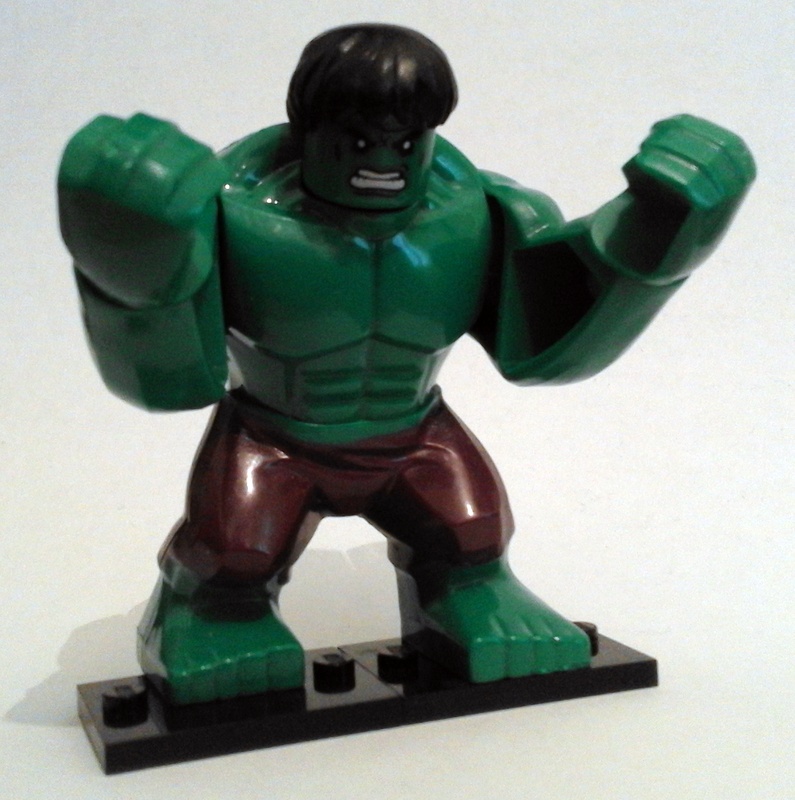
Officially the Hulk has been released by Lego in three forms - a Minifig, a Bigfig and one of those short-legged Mighty Micro ones. The Bigfig came in the 'classic' green with purple pants but has been bootlegged both in this scheme and many others, from grey and red skin to various pants colours. I'm not actually crazy for the Hulk so this one and one of the bootleg Minifigures was enough for me. As I've said before I find Bigfigs to be something of a cheat, especially when they're like Groot and just a statue which can be stuck on Lego bases. Hulk isn't as bad as that, with a Minifig-style head with removable hair, and it feels better having him tower over everyone. The moulded crouching pose works, articulation being limited to the arms, wrist and neck - and naturally this makes him to right size to square up to the bootleg Ben Grimm which seems to be largely based on the same cast.
Official Thor figures have naturally been very much based on Chris Hemsworth's live action incarnation, though his stubble has been interpreted as a full beard for most of these; the most common one found itself into a promotional polybag and is thus more common than most bootlegs. The bootleggers have got their mileage out of him anyway with several variations on the chest armour pattern and presence or otherwise of the cloak, most sticking with the long blond hair and beard combo. I always preferred the comic look but thankfully the pirates have me covered there, or at least near enough. There's a version that not only features a more complex armour pattern that includes the legs (not entirely comic accurate but better than plain) and a winged helmet that's a fair stab allowing for Lego-style proportions. This originally came with the obligatory bearded head but it's easy enough to switch a shaved face in; naturally the figure comes with Mjolnir, a moulded piece for the Lego version rather than an extant hammer part.
Thanks to the character always being cool but never given much spotlight and being brought to life so well by Robert Downey Jr even in third gear. As such the character's so far become the posterchild for the film universe as a whole, and the multiple armours used in the movies are manna for anyone up for a recolour. Lego themselves have put out 15 variants while those cunning bootleggers have added probably the same amount again, from early marks to bizarre schemes only occasionally glimpsed; only Batman comes close to matching the number of possible variants available. I do have a live-action version or two which I'll cover at some point but for this grouping I've gone with one of the few comic-influenced versions. I've not yet got one of the early flat metal or gold versions because I'm not crazy about them (though I am highly likely to buy some at one point or another as I am no longer in rational control of this). No, instead I've gone for the one figure to properly do the yellow/red scheme - an official Lego figure from the Mighty Micros subline. Aimed at young buyers, this consists of duelling short-legged characters in fun little vehicles. As such I needed to switch in some full-length red legs but aside from that he's very good fun for capturing the way the character appeared for much of the sixties and seventies, with the large visible mouth on the removable helmet (less crazy than many of the Mighty Micros figures, though the face inside is unhinged), the big round chest deco and the neat, clean colour scheme.
Jan's the sort of character that usually gets shafted in this sort of thing, being an unflashy stalwart for fifty years without ever threatening to truly break out, despite leading the team several times and naturally being embroiled in much of husband Hank Pym's storylines. The forthcoming Ant-Man and the Wasp film is likely to see daughter Hope getting most of the focus, Jan having only appeared in a brief flashback. As such there's been no official Lego figure and only one bootleg; this, like many of the Minifigures with no official release, is lifted from the Lego Marvel Superheroes game, the tampographs copied from the in-game model and applied to extant parts. As she's a figure in a suit with wings (using the fairy wing 'backpack') the result is rather good, even if it's naturally something of a shame she's in a sensible modern battlesuit rather than some of the insane outfits she's turned out in over the years. The game version had a black bob but the figure has a brown ponytail; this can be switched out easily naturally but I've actually got used to her looking like this.
ANT-MAN
This was basically the Minifigure that turned this from "hey, those are cool I'll pick up a few" to "OMG I MUST LET THIS TAKE OVER EVERYTHING". Hank Pym is one of Marvel's more interesting characters, if occasionally bizarre and controversial; unlike so many of his contemporaries he's undergone genuine character development over the years rather than periodic stunts; it was very edifying to see a somewhat low-profile character get some serious love in the Ant-Man film, even if it was via the backdoor as a support role. And the original Ant-Man costume is a period classic, with its' big fifties hangover helmet and neat red/black jumpsuit. I have no idea what the origin of this figure is - there's no official match, the Lego version of Hank Pym being the live action version with a black helmet to differentiate him from Scott Lang - but they nailed it. The helmet's slightly oversized but fits in nicely with the Lego ethos while the paint apps are just right; the only weirdness is the eyes being printed slightly too far apart, presumably to line up with the helmet's holes. Originally he came with a pair of brown spiders, the closest thing in the Lego menagerie to look anything like ants at the time I guess; it doesn't really work and part of me wonders if they couldn't have come up with an ant from scratch but then even bootleggers who aren't paying for rights have a budget and I'm happier that the money's gone to the helmet.
THE HULK
Officially the Hulk has been released by Lego in three forms - a Minifig, a Bigfig and one of those short-legged Mighty Micro ones. The Bigfig came in the 'classic' green with purple pants but has been bootlegged both in this scheme and many others, from grey and red skin to various pants colours. I'm not actually crazy for the Hulk so this one and one of the bootleg Minifigures was enough for me. As I've said before I find Bigfigs to be something of a cheat, especially when they're like Groot and just a statue which can be stuck on Lego bases. Hulk isn't as bad as that, with a Minifig-style head with removable hair, and it feels better having him tower over everyone. The moulded crouching pose works, articulation being limited to the arms, wrist and neck - and naturally this makes him to right size to square up to the bootleg Ben Grimm which seems to be largely based on the same cast.
THOR
Official Thor figures have naturally been very much based on Chris Hemsworth's live action incarnation, though his stubble has been interpreted as a full beard for most of these; the most common one found itself into a promotional polybag and is thus more common than most bootlegs. The bootleggers have got their mileage out of him anyway with several variations on the chest armour pattern and presence or otherwise of the cloak, most sticking with the long blond hair and beard combo. I always preferred the comic look but thankfully the pirates have me covered there, or at least near enough. There's a version that not only features a more complex armour pattern that includes the legs (not entirely comic accurate but better than plain) and a winged helmet that's a fair stab allowing for Lego-style proportions. This originally came with the obligatory bearded head but it's easy enough to switch a shaved face in; naturally the figure comes with Mjolnir, a moulded piece for the Lego version rather than an extant hammer part.
IRON MAN
Thanks to the character always being cool but never given much spotlight and being brought to life so well by Robert Downey Jr even in third gear. As such the character's so far become the posterchild for the film universe as a whole, and the multiple armours used in the movies are manna for anyone up for a recolour. Lego themselves have put out 15 variants while those cunning bootleggers have added probably the same amount again, from early marks to bizarre schemes only occasionally glimpsed; only Batman comes close to matching the number of possible variants available. I do have a live-action version or two which I'll cover at some point but for this grouping I've gone with one of the few comic-influenced versions. I've not yet got one of the early flat metal or gold versions because I'm not crazy about them (though I am highly likely to buy some at one point or another as I am no longer in rational control of this). No, instead I've gone for the one figure to properly do the yellow/red scheme - an official Lego figure from the Mighty Micros subline. Aimed at young buyers, this consists of duelling short-legged characters in fun little vehicles. As such I needed to switch in some full-length red legs but aside from that he's very good fun for capturing the way the character appeared for much of the sixties and seventies, with the large visible mouth on the removable helmet (less crazy than many of the Mighty Micros figures, though the face inside is unhinged), the big round chest deco and the neat, clean colour scheme.
WASP
Jan's the sort of character that usually gets shafted in this sort of thing, being an unflashy stalwart for fifty years without ever threatening to truly break out, despite leading the team several times and naturally being embroiled in much of husband Hank Pym's storylines. The forthcoming Ant-Man and the Wasp film is likely to see daughter Hope getting most of the focus, Jan having only appeared in a brief flashback. As such there's been no official Lego figure and only one bootleg; this, like many of the Minifigures with no official release, is lifted from the Lego Marvel Superheroes game, the tampographs copied from the in-game model and applied to extant parts. As she's a figure in a suit with wings (using the fairy wing 'backpack') the result is rather good, even if it's naturally something of a shame she's in a sensible modern battlesuit rather than some of the insane outfits she's turned out in over the years. The game version had a black bob but the figure has a brown ponytail; this can be switched out easily naturally but I've actually got used to her looking like this.
Comic Review: Heroes Reborn Part 3 - Iron Man #1-5
PUBLISHER: MARVEL, 1996
STORY: SCOTT LOBDELL & JIM LEE
ART: WHILCE PORTACIO (#1-3), RYAN BENJAMIN (#4-5)
Aside from scribbling an outline Jim Lee had little input into the second title Wildstorm handled during Heroes Reborn; instead it benefited from the presence of an actual proper comic writer in the form of the underrated (and I will fight anyone who thinks otherwise) Scott Lobdell while art was handled, initially at least, by Whilce Portacio, who joined up with Image along with the others but not as a partner. Like The Avengers, Iron Man was not in a good place when it was 'cancelled'; the series had slumped into a series of regurgitated plots in the nineties, with Tony Stark becoming an alcoholic, Tony Stark faking his death, Tony Stark getting Rhodey to be Iron Man, Tony Stark turning out to be a secret villain, Tony Stark getting killed off, Tony Stark being replaced by a teenage version of himself, etc, etc and so on.
Heroes Reborn allowed something of a rollback with the same revised origin as before as cold calculating business bastard adult Tony Stark gets injured by some shrapnel to the heart and becomes Iron Man to save himself, simultaneously having something of an epiphany and deciding to be less of an arsehole. There are some interesting tweaks here, though - one of the Heroes Reborn event's neater ideas is that Tony, Reed Richards, Victor von Doom, Bruce Banner and one Rebel Reilly were college buddies, styling themselves the Knights of the Atomic Round Table before various circumstances derail them from their utopian vision. Tony's fall was largely precipitated by fall-out from the death of the aforementioned Rebel (made up for these stories) while testing the Promethium armour Stark then dons as Iron Man, which is a better explanation for the guy having a battle suit floating around than having built one in a cave.
Another fun addition is Bruce Banner as a supporting character; the Hulk split in two during the closing moments of the Onslaught event, Bruce throwing himself in after the Avengers while the Hulk was left in the main Marvel universe as a bestial nutcase without Banner's personality elements, his title continuing. The Reborn versions of Leonard Samson, Betty Ross and Thunderbolt Ross are all in the cast, along with forgotten Iron Man regulars Pepper Potts (smack bang back in the middle of the story), Happy Hogan and Jasper Sitwell are also in the mix. However, Lobdell is a master of this sort of thing and most of them get some meat on the bones. Iron Man is kept largely clear of the Avengers at this stage as well.
The primary villains are Hydra, whose assault on Stark International gives Tony his heart injury and also sees Bruce - part of SI, constantly trying to find some conscience in his old friend - seemingly sacrifice himself keeping a government-backed gamma bomb out of their hands and getting turned into the Hulk for his trouble. Additional appearances come from a guesting Fantastic Four, a victim of Stark's corporate raiding who turns himself into the new Living Laser and then dies almost immediately and Whirlwind, who Stark doesn't even bother to armour up for. If there's a weak point it's the antagonists.
Portacio's art is as highly stylised as ever, all long necks and hanging locks of hair. It's not the prettiest of styles but it's easy to follow what's going on even if the early issues feature a lot of guys with longish black hair in suits, while I've always liked the armour redesign. Ryan Benjamin follows the style more or less with maybe less overt distortion but overall it's only behind Jim Lee's work on F4. Or only ahead of Liefield's on everything else if you're half-glass full.
The first chunk of Iron Man is no classic but to be the best start to a Heroes Reborn title it doesn't have to be, really. It's an entertainingly different start to Iron Man, a decent modernisation with a lot going on, even if that means by law of averages a couple of bits are silly.
STORY: SCOTT LOBDELL & JIM LEE
ART: WHILCE PORTACIO (#1-3), RYAN BENJAMIN (#4-5)
Aside from scribbling an outline Jim Lee had little input into the second title Wildstorm handled during Heroes Reborn; instead it benefited from the presence of an actual proper comic writer in the form of the underrated (and I will fight anyone who thinks otherwise) Scott Lobdell while art was handled, initially at least, by Whilce Portacio, who joined up with Image along with the others but not as a partner. Like The Avengers, Iron Man was not in a good place when it was 'cancelled'; the series had slumped into a series of regurgitated plots in the nineties, with Tony Stark becoming an alcoholic, Tony Stark faking his death, Tony Stark getting Rhodey to be Iron Man, Tony Stark turning out to be a secret villain, Tony Stark getting killed off, Tony Stark being replaced by a teenage version of himself, etc, etc and so on.
Heroes Reborn allowed something of a rollback with the same revised origin as before as cold calculating business bastard adult Tony Stark gets injured by some shrapnel to the heart and becomes Iron Man to save himself, simultaneously having something of an epiphany and deciding to be less of an arsehole. There are some interesting tweaks here, though - one of the Heroes Reborn event's neater ideas is that Tony, Reed Richards, Victor von Doom, Bruce Banner and one Rebel Reilly were college buddies, styling themselves the Knights of the Atomic Round Table before various circumstances derail them from their utopian vision. Tony's fall was largely precipitated by fall-out from the death of the aforementioned Rebel (made up for these stories) while testing the Promethium armour Stark then dons as Iron Man, which is a better explanation for the guy having a battle suit floating around than having built one in a cave.
Another fun addition is Bruce Banner as a supporting character; the Hulk split in two during the closing moments of the Onslaught event, Bruce throwing himself in after the Avengers while the Hulk was left in the main Marvel universe as a bestial nutcase without Banner's personality elements, his title continuing. The Reborn versions of Leonard Samson, Betty Ross and Thunderbolt Ross are all in the cast, along with forgotten Iron Man regulars Pepper Potts (smack bang back in the middle of the story), Happy Hogan and Jasper Sitwell are also in the mix. However, Lobdell is a master of this sort of thing and most of them get some meat on the bones. Iron Man is kept largely clear of the Avengers at this stage as well.
The primary villains are Hydra, whose assault on Stark International gives Tony his heart injury and also sees Bruce - part of SI, constantly trying to find some conscience in his old friend - seemingly sacrifice himself keeping a government-backed gamma bomb out of their hands and getting turned into the Hulk for his trouble. Additional appearances come from a guesting Fantastic Four, a victim of Stark's corporate raiding who turns himself into the new Living Laser and then dies almost immediately and Whirlwind, who Stark doesn't even bother to armour up for. If there's a weak point it's the antagonists.
Portacio's art is as highly stylised as ever, all long necks and hanging locks of hair. It's not the prettiest of styles but it's easy to follow what's going on even if the early issues feature a lot of guys with longish black hair in suits, while I've always liked the armour redesign. Ryan Benjamin follows the style more or less with maybe less overt distortion but overall it's only behind Jim Lee's work on F4. Or only ahead of Liefield's on everything else if you're half-glass full.
The first chunk of Iron Man is no classic but to be the best start to a Heroes Reborn title it doesn't have to be, really. It's an entertainingly different start to Iron Man, a decent modernisation with a lot going on, even if that means by law of averages a couple of bits are silly.
■■■■■■□□□□
Labels:
1996,
Comic,
Heroes Reborn,
Iron Man,
Jim Lee,
Marvel,
Ryan Benjamin,
Scott Lobdell,
Whilce Portacio
Subscribe to:
Posts (Atom)